Thomsen-space FWI with the pseudo-acoustic VTI propagator
deepwave.acoustic_vti() takes VTI stiffnesses (c11, c13, c33) directly, but practitioners usually reason and invert in Thomsen (1986) parameters (vp, epsilon, delta) instead. This is exactly the “converters” case in Model parameterisations: deepwave.anisotropy.thomsen_to_cij() is an ordinary differentiable function, so optimising vp/epsilon directly and rebuilding the stiffnesses each iteration composes with autograd for free:
def run(vp, epsilon):
    c11, c13, c33, _, _, buoyancy = thomsen_to_cij(vp, vs, rho, epsilon, delta)
    return acoustic_vti(
        c11=c11, c13=c13, c33=c33, buoyancy=buoyancy, grid_spacing=dx, dt=dt,
        source_amplitudes_sigma_v=source_amplitudes,
        source_locations_sigma_v=source_locations,
        receiver_locations_sigma_v=receiver_locations,
        pml_freq=freq,
    ).receiver_amplitudes_sigma_v
The pseudo-acoustic VTI system additionally requires epsilon >= delta everywhere, or it is ill-posed (see Pseudo-acoustic VTI wave equation). Rather than clamping epsilon (which would zero its gradient wherever the clamp is active), this example reparameterises epsilon = delta + softplus(epsilon_free), guaranteed >= delta for any real epsilon_free while staying smoothly differentiable – the same chain-rule pattern again, this time enforcing a physical constraint rather than converting units.
A small crosswell-style survey inverts for both vp and epsilon jointly from a uniform starting guess, using the masked-subregion pattern from Model parameterisations (as in Q (attenuation) inversion with the viscoacoustic propagator) to keep the update within a central region away from the sources/PML:
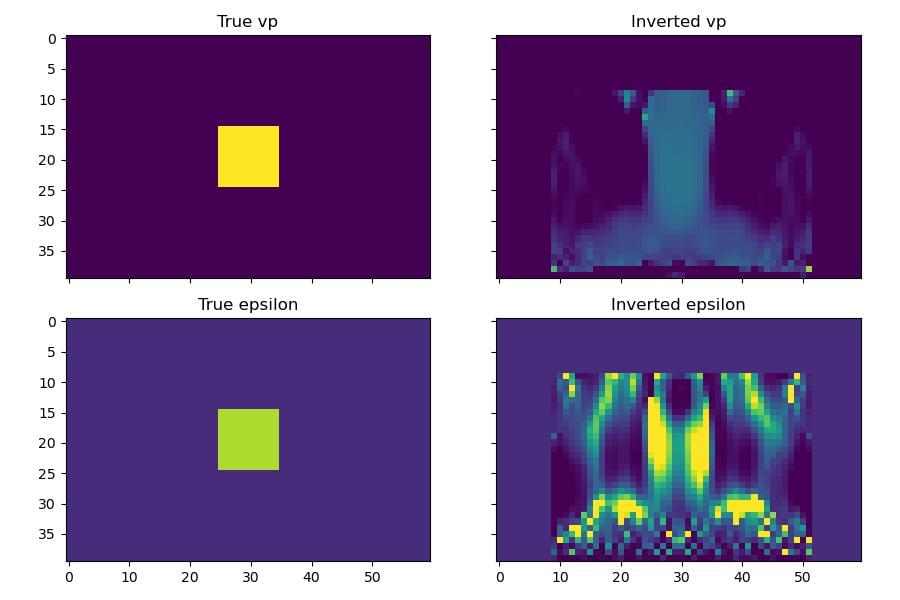
vp recovers most of the way to the true anomaly, but epsilon recovers only partially – a real, well-known trade-off in VTI FWI: anisotropy parameters need wider propagation-angle diversity than a narrow-aperture survey like this one provides, while vp is comparatively well constrained even at near-vertical incidence.