Elastic free-surface topography (surface_method=”pm”)
Deepwave represents a free surface – flat or arbitrarily rugged (staircase) topography – purely through vacuum cells (vp = vs = rho = 0, equivalently lamb = mu = buoyancy = 0); there is no separate surface-geometry argument. This example builds a small hill-and-valley terrain by zeroing the model above a topographic line:
vacuum = yy < surface.reshape(1, -1)  # everything above the surface
vp[vacuum] = 0.0
vs[vacuum] = 0.0
rho[vacuum] = 0.0
Passing surface_method="pm" selects the parameter-modified method of Cao and Chen (2018): in addition to the vacuum cells, the medium parameters at the solid cells lying on the discrete surface are modified once, before time stepping, so the stress-free condition is satisfied adaptively for any Poisson’s ratio – markedly more accurate than the default improved vacuum method (IVM) at large Poisson’s ratio, at no extra per-time-step cost. See Elastic wave equation and Boundary conditions for the full derivation and accuracy comparison.
A shallow vertical-force source placed directly on the surface generates a clear Rayleigh-type surface wave that visibly hugs the topography, distinct from the body waves radiating into the half-space below it. Receivers placed along the surface (following the terrain, not a flat line) record its moveout:
out = elastic(
    lamb, mu, buoyancy, dx, dt,
    source_amplitudes_y=source_amplitudes,
    source_locations_y=source_locations,
    receiver_locations_y=receiver_locations,
    surface_method="pm",
    backend="eager",
    pml_freq=freq,
)
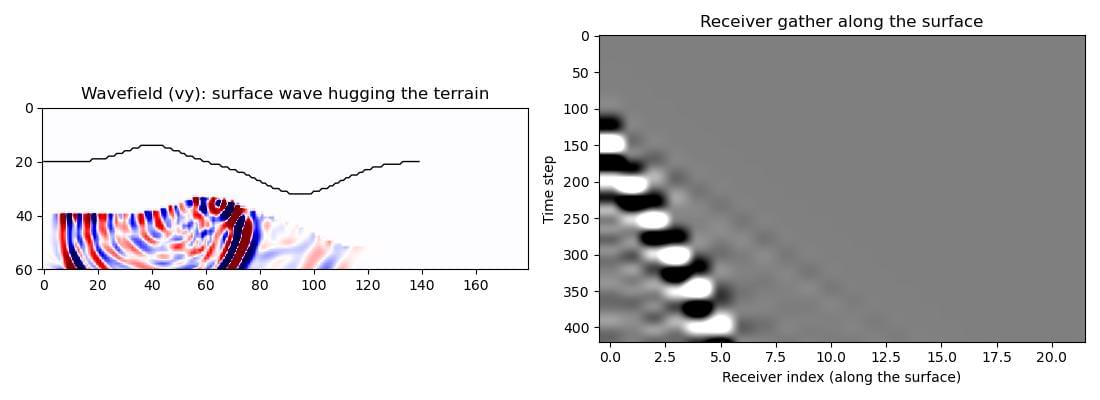
The left panel’s wavefield snapshot shows the surface-wave energy (the tightly-banded, high-amplitude arcs) tracking the black terrain outline as it climbs from the source, over the hill, distinct from the more diffuse body waves spreading into the interior below. The right panel’s receiver gather along the surface shows the corresponding clear moveout.