First-class boundary faces (free, rigid, periodic)
In addition to the default all-PML (absorbing) edges, every propagator accepts an explicit boundary argument that selects a boundary type per face – "pml" (absorbing), "free", "rigid", or "periodic" – rather than only the implicit zero-pml_width reflector. Which of those a given propagator accepts differs: deepwave.scalar(), used here, accepts all four on every face, while the other propagators accept fewer, and a face one does not accept raises rather than running. See Which faces each propagator accepts for the table, and Boundary conditions for the full derivation of each condition’s reflection coefficient and image formula; this example demonstrates the two qualitatively distinct behaviours side by side.
Free vs rigid reflection polarity
A source (with a co-located receiver) is placed close to one face of a small homogeneous model. Comparing the receiver trace for a "free" and a "rigid" boundary against a "pml" (absorbing, effectively reflection-free) baseline on that same face, and subtracting the baseline to isolate the reflected arrival, shows the two conditions’ opposite reflection polarity directly:
def run_trace(boundary, pml_width):
    return scalar(
        v, dx, dt,
        source_amplitudes=source_amplitudes,
        source_locations=source_locations,
        receiver_locations=receiver_locations,
        pml_width=pml_width,
        pml_freq=freq,
        boundary=boundary,
        backend="eager",
    ).receiver_amplitudes.reshape(-1)

trace_pml = run_trace(None, 15)
trace_free = run_trace(["pml", "pml", "pml", "free"], [15, 15, 15, 0])
trace_rigid = run_trace(["pml", "pml", "pml", "rigid"], [15, 15, 15, 0])
reflected_free = trace_free - trace_pml
reflected_rigid = trace_rigid - trace_pml
The two lists have to agree – a named face must have pml_width 0 – so deepwave.boundaries() will build them together for you, which is the less error-prone spelling of the same thing:
boundary, pml_width = deepwave.boundaries(2, width=15, dim1_end="free")
trace_free = run_trace(boundary, pml_width)
Contrast with a bare zero width. Writing pml_width=[15, 15, 15, 0] and no boundary also produces a reflecting face – but which condition it produces is implied rather than stated, it depends on the propagator and the field component, and it uses an approximate image rather than the exact one, so it carries a spurious reflection of a few percent above accuracy=2. Deepwave warns once when a face is created that way. See Reflecting edges for the measured coefficient of each propagator.
Periodic wraparound
With boundary=["pml", "pml", "periodic", "periodic"] (a "periodic" pair must cover both faces of the same dimension), energy that leaves one edge re-enters the opposite edge travelling in the same direction, rather than reflecting or being absorbed. A wavefield snapshot late in the simulation shows the propagating wavefront visibly wrapping around: the “bowtie” shape where the two halves of the circular wavefront meet is the same wavefront re-entering from the opposite side.
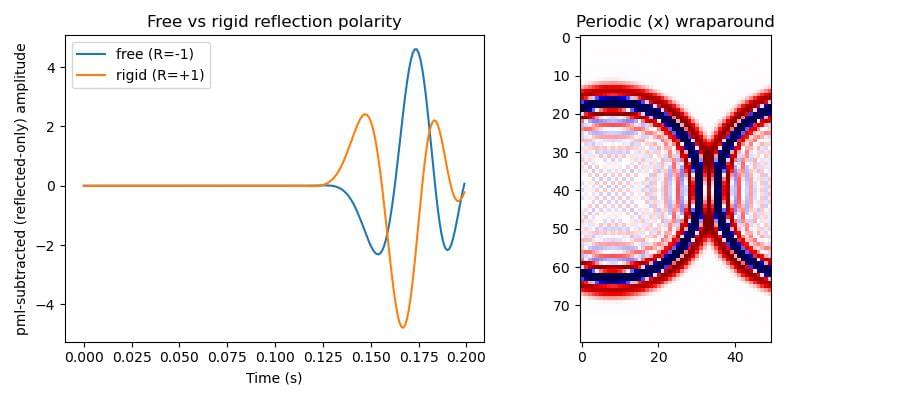
The left panel confirms the free surface reflects with inverted polarity (\(R=-1\), starts negative) while the rigid surface reflects with preserved polarity (\(R=+1\), starts positive) – exactly the opposite signs of the same magnitude reflection, as Boundary conditions derives. The right panel’s periodic boundary shows the wrapped wavefront re-emerging from the opposite edge of the domain.