LSRTM with the variable-density acoustic Born propagator
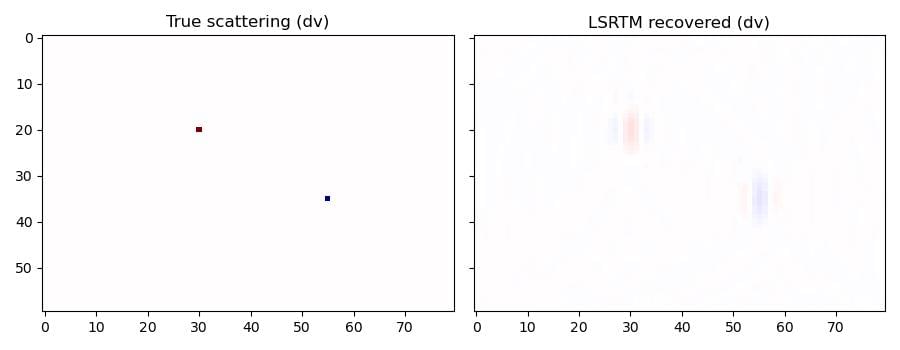
This is the deepwave.acoustic_born() analogue of Least-Squares Reverse-Time Migration (LSRTM), which uses deepwave.scalar_born(). It uses a small self-contained model (no external data download) with two point scatterers on top of a smoothly-varying background velocity, and inverts for the velocity scattering perturbation.
As in the scalar case, we first estimate the direct arrivals by forward modelling through the smooth background (migration) velocity with the regular, non-Born deepwave.acoustic() propagator, and subtract them from the “observed” data (here itself synthetic, generated by forward modelling through the true model) to get the scattered data that Born modelling should reproduce:
background = acoustic(
    v_bg, rho, dx, dt,
    source_amplitudes_volume_rate=source_amplitudes,
    source_locations_volume_rate=source_locations,
    sc_receiver_locations_p=sc_receiver_locations,
    pml_freq=freq,
    max_vel=float(v_true.max()),
).sc_receiver_amplitudes_p
observed_scattered = observed - background
We then invert for the scattering perturbation dv with LBFGS, exactly as Least-Squares Reverse-Time Migration (LSRTM) does for scalar_born, but through deepwave.acoustic_born():
dv = torch.zeros(ny, nx, device=device, requires_grad=True)
optimiser = torch.optim.LBFGS([dv])
loss_fn = torch.nn.MSELoss()

for _epoch in range(n_epochs):
    def closure():
        optimiser.zero_grad()
        out = acoustic_born(
            v_bg, rho, dx, dt,
            dv=dv,
            source_amplitudes_volume_rate=source_amplitudes,
            source_locations_volume_rate=source_locations,
            sc_receiver_locations_p=sc_receiver_locations,
            pml_freq=freq,
            max_vel=float(v_true.max()),
        )
        loss = 1e8 * loss_fn(
            out.sc_receiver_amplitudes_p, observed_scattered
        )
        loss.backward()
        return float(loss.item())

    optimiser.step(closure)
With only a handful of LBFGS iterations and a modest source/receiver aperture the recovered image is a smeared, migration-style approximation of the two true scatterers rather than a pixel-perfect recovery – the same qualitative behaviour Least-Squares Reverse-Time Migration (LSRTM) shows with its own few-iteration budget – but both the location and the sign (polarity) of each scatterer are recovered correctly: